LOPA and LOPA Facilitator Training
Master LOPA and Facilitate LOPA Sessions with Confidence
Interested in taking this course?
To see pricing create a free account or contact us for more information
Advance Your Career by Mastering LOPA and Driving Safer Operational Outcomes
LOPA (Layer of Protection Analysis) is a cornerstone of risk assessment in the process industry — but it's also one of the most misunderstood and inconsistently applied methods. This course is designed to change that.
Whether you're new to LOPA or looking to strengthen your understanding, this training gives you the technical knowledge, structured methodology, and leadership mindset needed to perform and support effective LOPA studies.
Fully aligned with IEC 61511, the course bridges theory and real-world application through detailed examples drawn from actual industry practice. You’ll learn how to develop scenarios, identify independent protection layers, apply risk criteria, and evaluate risk reduction without unnecessary complexity.
Participants who complete the course and pass the final exam will receive a Specialist Certificate, validating their applied knowledge and commitment to safety excellence.
Key Course Outcomes
- Understand the core principles and purpose of Layer of Protection Analysis (LOPA)
- Learn how to apply LOPA according to the state of the art in industry
- Learn how LOPA supports compliance with IEC 61511
- Learn about conditional modifiers and enablers
- Learn the difference between safeguards and IPLs
- Recognize and evaluate independent protection layers (IPLs) and risk reduction factors
- Learn how to document and verify LOPA findings for safety compliance.
- Understand how LOPA integrates with Functional Safety Management (FSM) and process lifecycle phases.
- Identify common pitfalls and misconceptions in LOPA and how to avoid them
- Earn a Specialist Certificate upon successful completion of the final exam
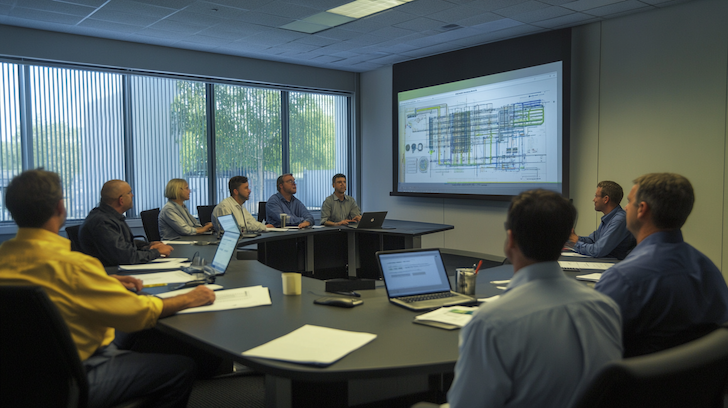
Module 1 - Introduction to LOPA
In this module we give a short introduction into safety instrumented functions and the role they play in terms of layers of production. Further more we address the rules that apply to SIFs.
Key topics:
- What is LOPA?
- What does LOPA do?
- Key features of LOPA
- History of LOPA
- LOPA and the law
- LOPA and standards
- LOPA and other HRA techniques
- Applications LOPA
- When to use LOPA
Module 2 - Functional Safety Management
In this module we explain what SIL Verification is, and what it is not. We clarify a few terms, including terms used in industry that are not used in the IEC 61511 standard. In the end you will understand how they relate together.
Key topics:
- The task of FSM
- Lifecycle phase
- LOPA and FSM
- LOPA team in a nutshell
- LOPA documentation
- LOPA report
- LOPA and verification
- LOPA and assessments
- LOPA and audits
- LOPA and validation
Module 3 - Principles of LOPA
Module 3 is were the actual verification work starts. We start with the most fundamental verification activity and that is the verification of the defined safety instrumented function
Key topics:
- Scenario
- Consequence
- Initiating event
- Enabling event
- Conditional modifier
- (Un)mitigated consequence
- Safe guards
- Independent protection layers (IPL)
- Protection layers
- The four LOPA steps
Module 4 - Preparing for LOPA
Once the SIF is clearly defined the safety requirements can be defined. In this module you learn how and what you need to verify when you verify the SRS.
Key topics:
- Initiating the LOPA
- Scope
- Objective
- The study plan
- The study team
- Meeting logistics
- Technical information
Module 5 - Performing LOPA
Based on the SRS safety devices are selected and bought that will eventually implement the SIF. In this module you learn how to verify that safety equipment is actually SIL compliant.
Key topics:
- During the meeting
- Introduction sessions
- Examination session
- Closure session
Module 6 - LOPA Reporting
The SIL compliant devices are used to build the architecture of the SIF. But there are rules for building the architecture. In this module you learn how to verify the architecture according to IEC 61508 and IEC 61511 rules.
Key topics:
- Recording of the proceedings
- LOPA Study report
- Software tools
- Methods of recording
- LOPA Worksheet
- Mark up drawings
- Documenting recommendations
- Finalising off and approval
Module 7 - After the LOPA
Only after the architecture has been decided and the devices have been selected is it possible to perform a PFD calculation. In this module we teach you how to verify the PFD calculation. Or how to perform the calculation yourself, which then needs to be verified. We will give a demonstration of our online PFD calculation tool as well.
Key topics:
- What is not the responsibility
- Responsibility (FS) manager
- Close action items
- When to do the LOPA again
Module 10 - Conclusions
Last but not least we need to verify the FAT, iFAT and SAT. In the module we teach you the difference between the different validation tests and how to verify them
Key topics:
- Advantages LOPA
- Disadvantages LOPA
- LOPA Pitfalss
Exam
Optional - Workshop
Role Certification - Professional LOPA Facilitator
KNowledge and ROLE Certifications
YOur certification optionS
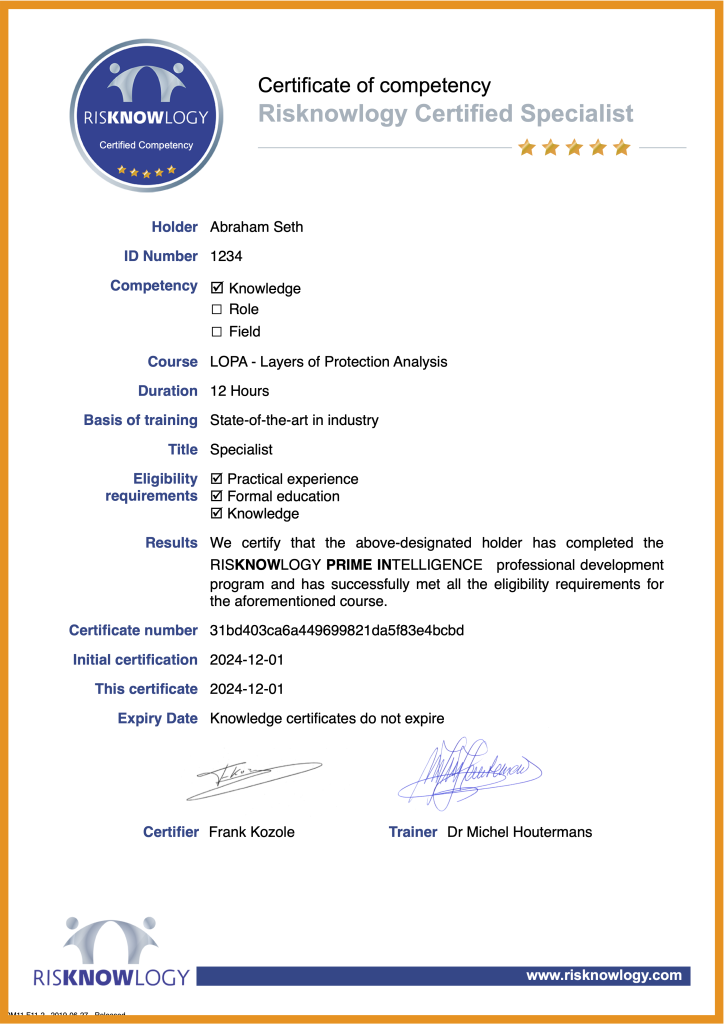
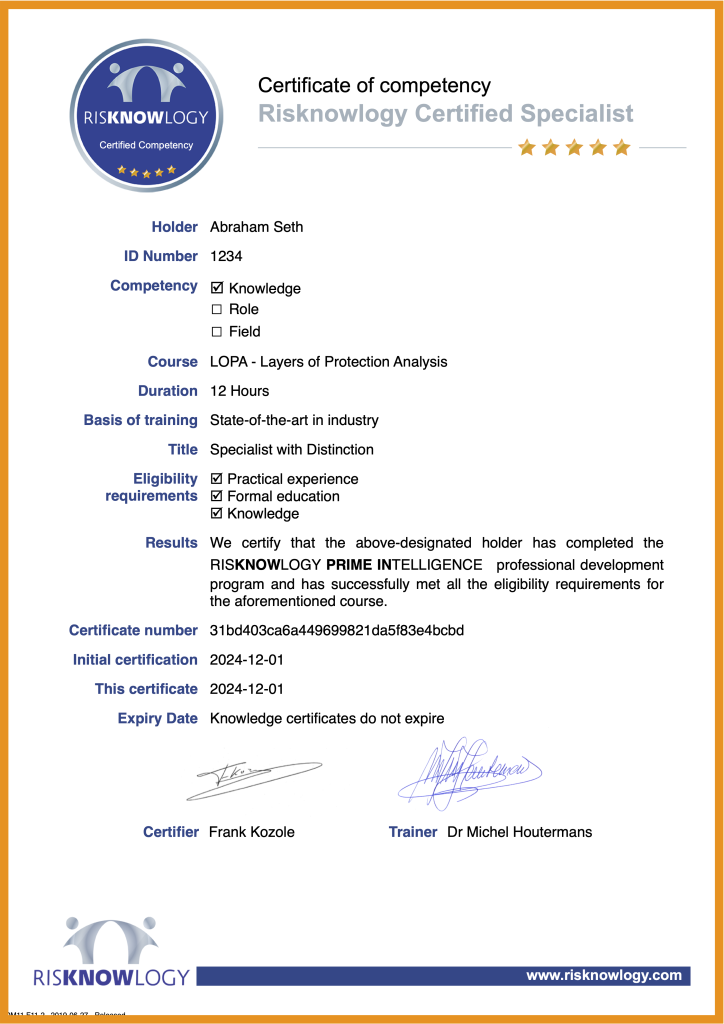
You can follow this training with or without certification. When you choose to do the exam you can get a Risknowlogy Specialist certificate or Specialist with Distinction certificate in the field of Layers of Protection Analysis.
There Is a Higher Level of Certification As Well.
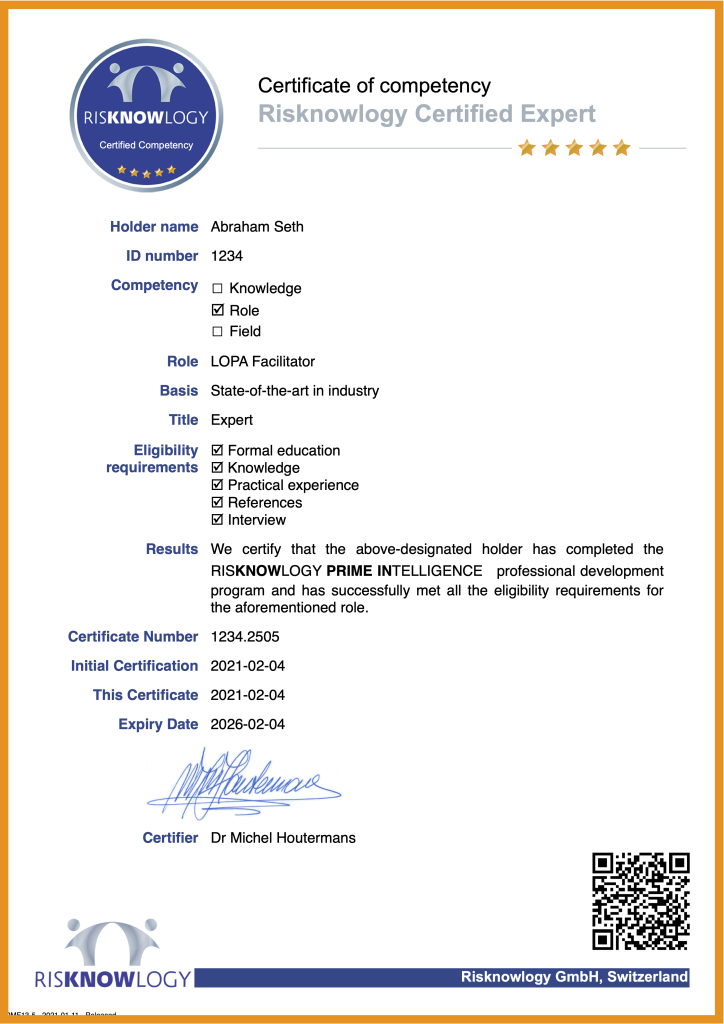
This is a higher-level certification and focuses on practical experience you have as a LOPA Facilitator. With this course, you can get a combo deal if you want to include the certification of your practical experience as well. If you do not have practical experience yet we will help you. To achieve this certification, you need to:
1 - Submit 2 case studies using our template. (You get the template if you select this option).
2 - Submit two references.
3 - Interview (for Expert and Master).
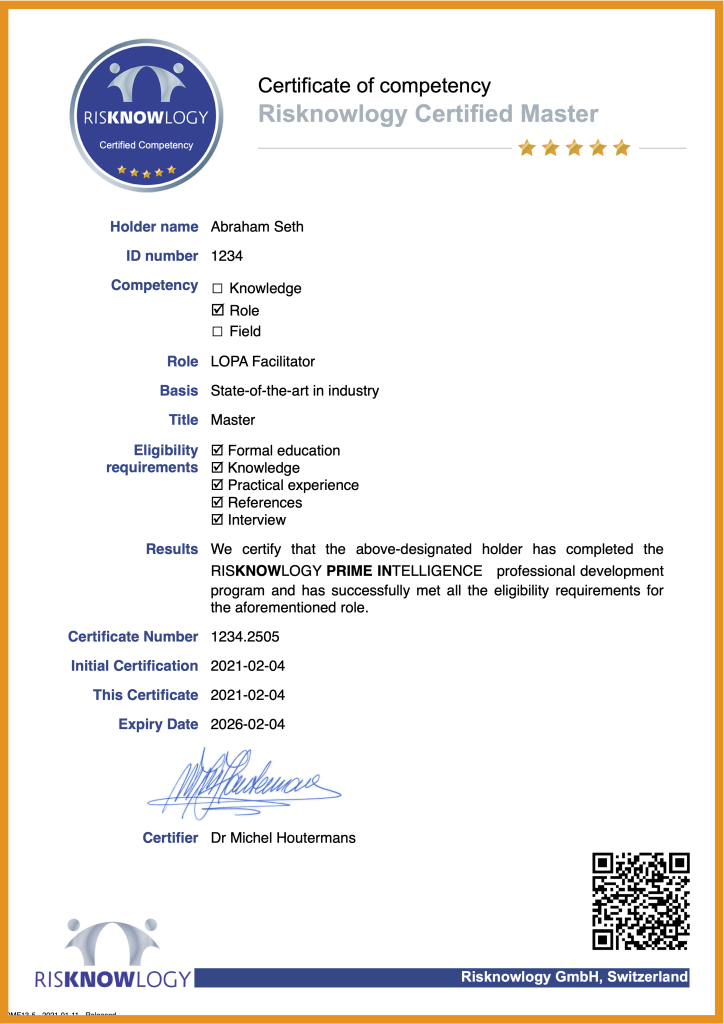
The certification title depends on the number of hours you can prove. Based on this course, you can achieve Professional. But if you have enough hours also qualify as Expert or Master LOPA Facilitator.
Knowledge Certificate - Specialist in LOPA according to the state-of-the-art in industry
RISKNOWLOGY
SPECIALIST
RISKNOWLOGY
SPECIALIST
With DISTINCTION
Role Certificate - Certified LOPA Facilitator
RISKNOWLOGY
Expert
RISKNOWLOGY
MASTER
Dr Michel Houtermans

Fiorenzo C
I am very happy I got the certification as a EXPERT LOPA FACILITATOR. Together with the MASTER HAZOP CHAIRMAN certification (obtained more than five years ago), it represents a significant professional acknowledgement, in particular with reference to the work carried out in all these years, as well as considering the seriousness of the certification process (proven experience, references, submission of case studies, final interview). These certifications represent for me an important business card for existing and new Customers and Colleagues.

Brahim
Useful, practical. This course helped me to improve my understanding about functional safety management and LOPA.

Vinayak S.

George S.
The training materials are very good and easy to understand in terms of practicality. Overall the course is structured nicely and the delivery of the course is fantastic. Keep up the good work.

Kamal A.
That was a great course. I have sharpened my knowledge on FSE, and go a more precise understand of some definitions and methodology related to layer of protection analysis.

Ahmed A.
Pure tech course. Loved it. Specially sequence of LOPA and systematic approach to have it done.
Frequently Asked Questions
What is the difference between Self-Study, Live Online and In-Person
- Self-Study: Self-study refers to the process of learning independently without direct supervision or guidance from a teacher or instructor. In many instances we do have periodic live Q&A sessions.
- Live Online: During live online training participants attend live sessions conducted by an instructor or trainer through MS Teams or Zoom
- In-Person: During in-person training participants and trainers gather together physically in the same location for example your company office or a hotel.
Can I cancel and get a refund if I'm and not satisfied?
Self-Study courses
- The course comes with a 7 day money back guarantee.
- Exception: Once you have earned your Course Certificate, you are no longer eligible for a refund, even if you earn your Certificate within the 7 days refund period.
- You can request a refund up until 1 day before the training course starts.
- You can request a refund up until 7 days before the training course starts.
When can I do the exam?
- Self-Study: The exam is available at any time. You can do it as soon as you feel confident.
- Live Online: As soon as the course is finished
- In-Person: As soon as the course is finished