Event Tree Analysis (ETA) — What It Is and How It Works
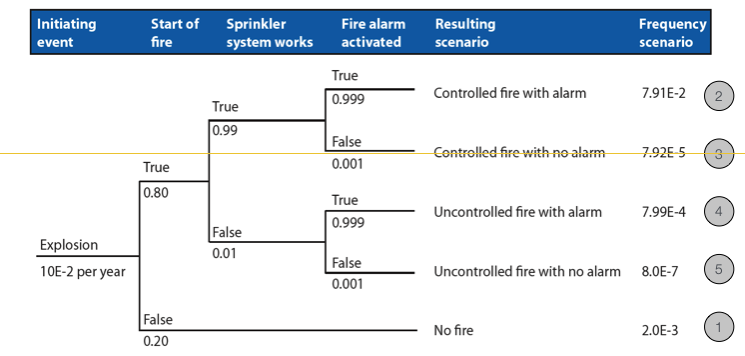
Event Tree Analysis (ETA) is a forward-looking risk assessment tool used to explore the different outcomes that can result from a single initiating event. It maps possible scenarios step by step, showing how protective systems and human actions influence the outcome.
What is Event Tree Analysis?
ETA is a structured, visual method that helps you answer the question: if this goes wrong, what happens next? Starting from an initiating event, the tree branches at each point where a safety function or human action may succeed or fail — leading to different end states, each with its own risk level and probability.
The key question is: if a hazard occurs, can you map every possible outcome — and show which barriers determine the result?
Why use ETA?
ETA is widely used across industries including:
- Process industry
- Nuclear plants
- Chemical plant safety
- Process and system hazard analysis (HAZOP follow-ups)
- Functional safety (e.g. IEC 61508, ISO 26262)
- Natural disaster modelling (e.g. rockslides and tsunamis)
Benefits of ETA
- Easy to understand and communicate
- Helps identify system weaknesses
- Supports compliance and safety design
- Can be qualitative or quantitative
Key concepts: initiating and pivotal events
- Initiating Event (IE): The first significant failure or disturbance (e.g. fire, system error)
- Pivotal Events (PEs): Key points in the scenario where a safety function may succeed or fail
- End States: The possible outcomes (e.g. no damage, partial damage, catastrophic loss)
Each path through the tree represents a different scenario — each with its own risk level and probability.
Step-by-step: how to build an event tree
- Define the initiating event — e.g. fire in a control room.
- List the pivotal events — e.g. fire detection, alarm, sprinkler, operator response.
- Map out each success/failure point. Each decision branches the tree.
- Create all paths to end states. Each path equals a scenario.
- (Optional) Assign probabilities using historical data or expert judgement.
- Analyse the results. Identify critical failures, success paths, and improvement areas.
Real-world example: reactor coolant loss
This example is based on nuclear risk modelling:
- A small pipe crack causes coolant to leak
- The High Pressure Injection System (HPIS) must activate
- If it fails, the Low Pressure Injection System (LPIS) is next
- If LPIS also fails, the operator must act quickly
- Depending on what works and what fails, the outcome ranges from full recovery to core damage
This scenario is often used in training and simulation across safety-critical industries.
ETA vs. Fault Tree Analysis (FTA)
| Feature | ETA | FTA |
|---|---|---|
| Logic Direction | Inductive (forward-looking) | Deductive (root cause focus) |
| Starts With | A trigger or failure event | A top-level system failure |
| Focus | Scenario outcomes | Cause diagnosis |
| Best For | Understanding consequences | Tracing failure origins |
Tip: ETA and FTA are often used together. FTA informs the probabilities that feed into ETA.
How ETA supports better decision-making
ETA helps you:
- Design more resilient systems
- Visualise worst-case and best-case scenarios
- Support functional safety assessments (SIL, LOPA)
- Improve operator training and simulations
- Prioritise mitigation strategies
- Communicate complex risk scenarios to stakeholders
Final thoughts
Event Tree Analysis is a simple yet powerful tool. Whether you are working in process safety, energy, manufacturing, or infrastructure — ETA helps you prepare for the unexpected, communicate risk, and make better decisions.
Train and certify with Risknowlogy
Risknowlogy delivers expert-led training in functional safety, risk assessment, and hazard analysis — with internationally recognised certification included.
Explore courses → Ask us a question