Formulas
The SIL Master module performs hardware integrity analysis according to the following standards:
- IEC 61508:2010
- IEC 61508:1998 (Obsolete)
- ISA TR84.00.02:2022
- VDE/VDI 2180:2019
- PFD formulas
IEC 61508:2010 formulas
SIL Master can perform PFDavg and PFH calculations according to IEC 61508:2010.1oo1 Formulas


1oo2 Formulas


1oo2D Formulas


2oo2 Formulas

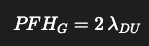
2oo3 Formulas


Supporting formulas


ISA TR84.00.02:2022 formulas
SIL Master can perform PFD, PFH and STR calculations according to ISA TR84. The formulas use are coming directly from this technical report.PFD Formulas
where
- DC is the diagnostic coverage - parameter from device, calculated or given
- DI is the diagnostic interval - is a parameter on subsystem level (hours)
- TI is the proof test interval - is a parameter on subsystem level (hours)

According to the TR84 document you provided, the definitions for N, M, and R in the context of the formula used for calculating the probability of failure on demand (PFDavg) are as follows:
- N refers to the total number of devices in the voting configuration. This represents the full set of redundant elements being considered for failure or success.
- M represents the minimum number of devices out of the total N devices that must operate correctly for the system to be considered successful. This is often referred to as M-out-of-N voting logic (e.g., 2oo3 means 2 out of 3 must work).
- R represents the number of common-cause failures, which are addressed in the equation by considering failure dependencies across devices. R=N−M+1
PFH Formulas
The following subsystems can be calculated with PFH formulas: 1oo1, 1oo2, 1oo3, 2oo2, 2oo3, 2oo2STR formulas
The following subsystems can be calculated with the STR formulas: 1oo1, 1oo2, 1oo3, 2oo2, 2oo3, 3oo3, and 3oo4

where


where
VDI/VDE 2180:2019 formulas
SIL master can perform PFD calculations according to VDI/VDE 2180:2019. The formulas use are coming directly from this standard.PFD Formulas
The following subsystems can be calculated with the PFD formulas: 1oo1, 1oo2, 1oo3, 2oo2, 2oo3, 3oo3


Formulas based on PFD1oo1
When you have a device without failure rates, but with a PFD value then we can still use this device to calculate PFD values for other architectures. We use the following formulas:PFD1oo1
Select a device that has a PFD value or calculate PFD based on the failure rates.PFD1oo2 and PFD1oo2D
We use the following formula:
PFD1oo2 and PFD1oo2D
We use the following formula:
PFD1oo3
We use the following formula:
PFD2oo3
We use the following formula:
PFD3oo3
We use the following formula:
PFD2oo4
We use the following formula: